
It is HN's favorite pitch for Elixir and the BEAM, credited with convincing many people to adopt them.
Topics › Systems, Networks & Security
The best distributed systems videos, according to Hacker News
80 videos about distributed systems that Hacker News commenters keep pointing each other to, ranked by how many separate months they were recommended. Part of Systems, Networks & Security.
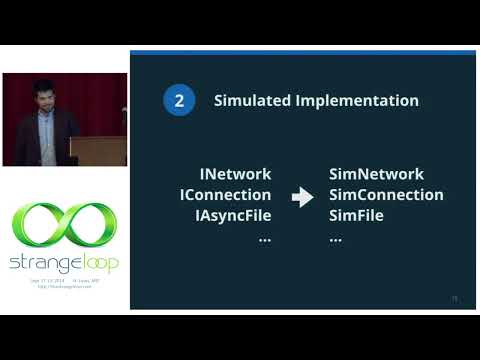
HN treats it as the canonical talk on simulation testing and a mind-blowing example of how far rigorous testing can go.

The go-to talk showing how Erlang let a tiny team run a massive messaging system.

Commenters repeatedly cite it as the talk that reframed how they think about caching, derived data and event sourcing.

HN recommends it as a key Hickey talk on system design that changes how people think about distributed state and interfaces.

The canonical recommendation for learning Go concurrency, praised as entertaining and clarifying when to use channels versus mutexes.

Treated as the go-to approachable yet deep primer on CRDTs and collaborative editing, recommended repeatedly in threads on Automerge, local-first software and OT versus CRDT.

HN treats it as the best introduction to Unison, with commenters finding hash-addressed immutable code mind-blowing.

Recommended as a clear, lucid way to learn Paxos and Multi-Paxos, ideally alongside the companion Raft video.

HN recommends it as the best video introduction to the actor model, straight from its inventor, and revisited it after Hewitt's death.

HN regards it as one of the best technical talks, a deep and clear walkthrough of scalable lock-free hash tables built on compare-and-swap.

Recommended as a fantastic introduction to declarative and Datalog-based distributed systems and failure modeling.

HN regularly recommends the series as a free, accessible, theory-oriented course on distributed computing that complements his book Designing Data-Intensive Applications.

Recommended as the standard free course for learning distributed systems from real papers.

Recommended for its practical strategy for preserving state on ephemeral containers, and for the live demo.

HN recommends it as a rare real-world look at a large fault-tolerant Erlang/Elixir system with no downtime in healthcare.

HN points people to it as Lamport's own case for thinking and writing a spec before coding, and as an entry point to TLA+.

HN recommends it as a fascinating explanation of queues, flow control and overload that applies well beyond Clojure.

HN treats Hamilton's annual talks as the best window into how AWS regions and hardware are actually built.

HN commenters point to it as a first-hand overview of Heap's Postgres/Citus architecture and its distinctive indexing approach.

Recommended as a detailed, candid case study of scaling a real system from zero users to millions.

HN considers it one of the best game networking talks, with insights that carry over to distributed systems generally.

HN recommends it as a transparent MMO postmortem and as the source of the story that the term 'shard' originated with Ultima Online.

HN recommends it as an excellent talk on generalizing deterministic simulation testing, and Antithesis hiring posts link it to explain the work.

HN people recommend it as a must-watch for anyone running complex systems, and some rewatch it regularly to remember its principles.

Strongly recommended as a clear, accessible survey of the CRDT landscape.

Recommended as an approachable introduction to CRDTs and the local-first idea behind apps like Actual.

HN recommends it as an illuminating, approachable explanation of distributed consensus.

HN commenters recommend it as a clearer introduction to Raft than the paper and as part of a well-designed understandability study.

HN points to it as an accessible explanation of microkernel isolation and fault-tolerant design, and as Tanenbaum's answer to performance objections.

HN recommends it as a classic look at systems engineering at Google, whose fundamentals have held up well despite its 2010 date.

A beloved classic that HN recommends as the quickest way to see why Erlang is special.

HN engineers recommend it for its core insight that limiting concurrency naturally yields request-rate limits, and for its link to queueing theory.

HN recommends it for getting the inventors of major concurrency models together, disagreements included.

Recommended as the best short overview of why the BEAM and Elixir stand apart from other runtimes.

Recommended as an excellent first education on CRDTs and their limits.

Cited by big-block advocates as evidence that Bitcoin could handle far higher throughput.

HN recommends it as a charming, concise demonstration of what makes Erlang special, from the people who built it.

HN points to it as a simple diff-and-patch alternative to operational transforms and CRDTs for collaborative editing.

Pointed to as the best source on Phoenix Presence internals and for combining Phoenix with Elm.

Recommended as a concise, high-level intro to what TLA+ is and when it helps.

Often brought up as an honest account of microservice sprawl, including the fact that nobody at Uber knew exactly how many services existed.

Recommended as the thorough case for replacing TCP in datacenters and for Ousterhout's Homa protocol.

HN recommends it for Hightower's clear mental models, such as comparing the scheduler to Tetris and explaining why resource limits matter.

Pointed to as a rare look at how a tiny engineering team ran WhatsApp's massive scale on FreeBSD and Erlang.

HN treats it as a classic that shows what Erlang was built for: robust, concurrent telecom systems with live upgrades.

Pointed to as evidence that Java can do fast, cheap message-passing concurrency, as an alternative to Erlang or Scala actors.

Recommended as a compact preview of Kleppmann's data systems material, including from his book on the subject.

HN lists it among the best early resources for learning what IPFS is and does.

Cited in decentralization and federation debates as the key talk on the practical challenges, though some found it defeatist.

HN points to it as an authoritative overview of AWS infrastructure, including what AZs and regions really mean.

Commenters point to it as a short, high-level overview of how Lightning payment channels work.

HN cites it as the authoritative description of Lambda internals and isolation, by the engineers who built it.

Recommended as a conceptual rather than code-heavy talk on failure recovery from Erlang's creator.

Recommended whenever local-first software, sync engines and CRDT alternatives come up, as a practical production account.

Cited as the explanation of how Linear's fast, locally synced UI works.

HN recommends it as a rich, concrete look at real-world system design and as evidence of YouTube's early Python stack.

Pointed to as the canonical pitch for Erlang's fault-tolerance and self-healing model.

HN threads link it as the primary source for Matrix's performance claims and sliding sync improvements.

Recommended as an entertaining cautionary talk on microservice failures and Conway's law.

It is the go-to reference whenever HN discusses cell-based architecture and outage isolation, as an explanation straight from AWS engineers.

Recommended as the protocol designer's own detailed explanation of SCP.

HN points to it as an authoritative look at DynamoDB internals and as evidence it is a complex distributed system.

HN cites it as a rare public look at Google's internal network design and how it scales to many VMs.

HN mostly cites it as evidence that YouTube was built on Python and as background on how it scaled.

Mostly cited as a source for details of Cloudflare's architecture, such as LuaJIT-based request inspection and request volumes.

HN commenters cite it in event sourcing threads for Young's views on when to use it, including advice against cross-application event sourcing.

Cited in sync-engine and local-first threads for Kleppmann's argument for a generic, standardised sync protocol or service.

HN points to it as insight into how AWS thinks about distributed systems and the difficulty of consensus.

Cited as a useful taxonomy for pinning down what an event-driven design actually is.

Cited as a primary source for Google building its own switches and running OpenFlow in production.

Cited in backup and data-loss threads as a rare inside look at Google's backup practices, including its use of tape.

Cited as a technical look at how Tesla's VPPs and Autobidder work as distributed systems.

HN cites it as a primary source for Lamport's relativity inspiration behind logical clocks in distributed systems threads.

HN cites it for insight into Google researchers' views on AI progress and publishing, though one commenter finds the interview weak.

HN posts it in Kafka-as-database debates and as an introduction to event logs and CQRS.

Mentioned as a real-world example that microservices can work at scale, though commenters are lukewarm and unsure it matches what they remember.

Cited as a source for the fact that OpenAI uses Ray for training, and for Brockman's views on developer speed.

Cited as the primary source for why Netflix uses FreeBSD and UFS rather than ZFS on its CDN boxes, and for its GPL reasoning.

Cited as a real-world enterprise Java example, especially for JDK upgrades and ZGC results.
Which of these have you already seen?
Connect YouTube and HackerTube AI hides what you've watched and ranks the rest for you.