
HN repeatedly recommends the series it launched as the best way to understand how a CPU works, praised for Eater's clear teaching.
Topics › Hardware & Electronics
The best computer architecture & cpus videos, according to Hacker News
148 videos about computer architecture & cpus that Hacker News commenters keep pointing each other to, ranked by how many separate months they were recommended. Part of Hardware & Electronics.

HN calls it mandatory viewing on the AGC, praising the speaker's enthusiasm and the clear account of restartable, robust software design.

HN repeatedly recommends it as the best hands-on way to understand how a CPU and a computer work from first principles.

Recommended for years as the best technical introduction to memristors from the person who found the physical device.

HN treats it as the standard starting point for Game Boy emulator writers and homebrew developers, with several calling it one of their favorite talks.

HN recommends it, long as it is, as an eye-opening rant on software complexity and why systems became so complicated.

Repeatedly recommended as a revelatory talk on how little control the main OS has over modern SoCs and PCs.

HN cites it whenever chip architecture, Moore's Law or CPU design comes up, as an unusually deep and accessible view from a top designer.

Repeatedly called the best and most comprehensive AGC talk, with commenters rewatching it and treating it as foundational computer architecture learning.

The go-to citation in Moore's Law threads, a convincing counterargument from a top CPU designer.

It is the favorite recommendation for understanding Moore's minimalist, low-power multi-core designs and stack machines.

HN fans hold it up as a favorite among his videos and an example of gloriously bonkers technical art, and cite it in floating-point discussions.

Frequently recommended as the clearest plain-language explanation of what a computer fundamentally is, with at least one commenter saying it changed how they think about programming.

HN recommends it as a clever, entertaining and easy-to-follow talk on finding hidden x86 instructions with the Sandsifter tool.

HN points to it constantly in console, DRM and hardware-security threads as the authoritative account of Xbox One's threat model.

HN people recommend it to anyone wanting a practical sense of what CPUs can really do and why abstraction layers cost so much performance.

HN treats it as the classic go-to for learning atomics and memory ordering, recommended over books.

HN commenters recommend it as a clear, comprehensive explanation of USB signaling and keyboard polling.

HN readers recommend it as the best introduction to robust-first computing, where randomness and fault tolerance are built into the architecture.

HN recommends it for showing how old developers exploited the smeary nature of composite signals and what CGA really looked like on period hardware.

HN points to it whenever Hetzner comes up, as the best look inside their unusual, semi-custom and low-cost data center setup.

HN treats Cliff Click's talks as an excellent source on JVMs, garbage collection and hardware-assisted Java.

HN points to it as the founders' own explanation of what Oxide is building and why, a frequent link whenever Oxide comes up.

HN uses it to illustrate physical latency limits and why performance and distance matter in computing.

Treated as the accessible reference on analog computing for neural nets, especially the Mythic AI segment.

HN points to it as evidence of SpaceX's serious simulation capability and as a showcase of GPU compute for CFD.

Commenters recommend it as a clear, well-animated explanation of memory, especially for visual learners.

Recommended as a fascinating look at easy parallelism abstractions, though other commenters note the approach never beat sequential C by much.

HN treats it as required viewing for understanding the PS5's SSD and architecture beyond raw specs.

HN recommends it as real on-the-ground reporting on how banned GPUs get into China despite export controls.

HN recommends the series as a practical introduction to nMigen and formal verification for CPU design.

HN regulars treat Domas as a favorite hacker and bring this talk up in any discussion of CPU backdoors, hidden instruction sets or processor security.

Recommended as the best presentation on how modern CPUs run code, and why speculative execution matters for performance.

HN repeatedly recommends it as the best overview of the past, present and future of chip performance after Moore's law.

HN recommends it as a short, clear explanation of robust-first computing by its originator, and as a philosophy relevant to building with unreliable components like LLMs.

HN recommends it as an interview dense with insight from Keller, worth hearing in full even for non-engineers.

HN points to it as the go-to explanation of why memory layout beats pointer-chasing structures on real hardware.

HN recommends it as an enlightening explanation of atomics, caches and memory ordering from a strong presenter.

HN people treat it as the canonical C64 talk and rewatch Steil's 'Ultimate' series regularly.

Recommended as the key video for understanding control logic and microcode.

HN recommends it as a great walkthrough of chip reverse engineering and the story of Visual 6502.

Used as evidence that CPU speed for branchy, dependent code has improved only modestly in 15-20 years, so software optimization matters.

Recommended as an accessible tour of modern mainframes that compares them sensibly to ordinary server setups.

Recommended for explaining where the compiler ecosystem lacks standardization for accelerators and why efforts like MLIR and CIRCT matter.

HN passed it around in 2009 as a funny, impressive demo of SSD speed despite its marketing origin.

Recommended as a stellar long-form interview with someone both very smart and wise, mined for CPU design insights.

HN points to it as a technical talk from a chip designer on why AI hardware should put memory close to compute and use async data transfers.

HN recommends it as an in-depth, practical introduction to atomics and weak versus strong memory ordering, relevant to ARM and Rust as well as C++.
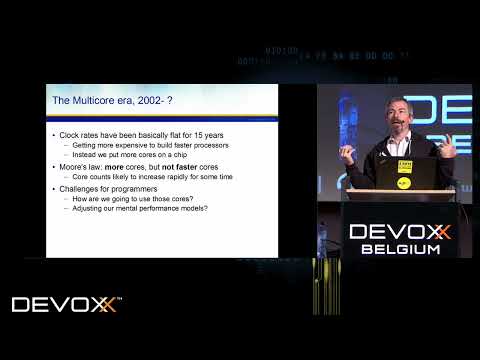
Recommended as an accessible refresher on how modern hardware and caches affect software performance.

Recommended as a clear, approachable explanation of how retro graphics hardware actually worked.

HN recommends it as an excellent history of the famous ABIT BP6 board.

HN commenters call his x86 internals talks spectacular and mention them whenever low-level processor surprises come up.

Recommended in DX7 reverse-engineering threads as a look at the effort behind bit-accurate emulation.

Cited in floating-point threads as the main introduction to posits and unums as an alternative to IEEE floats.

Recommended as an overview of Intel's anti-competitive past and why it kept dominating despite AMD's competitive products.

HN people cite it as detailed data on mobile SoC efficiency, sustained performance and ARM core efficiency curves.

Recommended as the definitive retrospective on 3dfx, with first-hand stories about engineering hacks and design philosophy.

Recommended as a fun, practical talk on why bit flips matter for security, and cited in ECC memory discussions.

HN points to it as an entry into Ackley's indefinitely scalable computing project, with a network-switch demo recommended as the best place to start.

HN commenters cite it as an informative talk from a leading researcher in reversible computing, mainly in threads on reversible computers and energy efficiency.

Cited as primary-source evidence that RISC-V code density is competitive with or better than ARM and x86.

HN recommends it as a window into Moore's minimalist CPU design and the GA144 chip, despite the slow pace.

HN recommends it as a history and analysis of the end of scaling from a well-regarded systems speaker, and lists it among the best talks of 2019.

HN points to it for an insider view of why NVIDIA's AI gains came from design rather than process, and for data-movement power costs.

HN people recommend Ben Eater's videos for easy, clear explanations of digital logic and building computers.

Recommended as a wonderful overview of the AGC architecture, though one commenter found it uninspiring.

Recommended as a documentary on the hardware shortage told from the perspective of consumer-facing companies, and cited in threads on RAM prices and ownership.
HN recommends it to explain why Pi supply favored business customers during the shortage, straight from a founder.

HN commenters cite it as an entertaining example of a teenager buying, hosting and booting a real mainframe.

HN cites it as Oxide's own explanation of how they ship hardware as a startup and why they picked illumos.

Recommended as a decent introduction to the Vampire accelerator and a cheaper way to modernize classic Amigas.

HN points to it as a convincing energy-budget analysis in debates over space datacenters, while debating its assumptions.

Pointed to as a primary-source interview on Apple's architecture transitions, emulation and microcode work.

Recommended as a simple, fun explanation of why floating point gives odd errors like 0.1 + 0.2.

Pointed to as a look at Hetzner's unusual semi-custom server hardware and cooling.

Cited as evidence that Eco Mode gives large power savings for a small performance loss on Zen 4.

Recommended in threads about SGI and vintage workstations as a good look at the hardware.

HN commenters cite it for the claim that process scaling beyond 28nm is uneconomic and for dark silicon.

HN points to it as coverage of an impressive 3D game port on very limited hardware.

Pointed to as a clear visual reference for chip manufacturing steps.

Used as a primary source for 6502 origins, pricing strategy and Commodore history.

Recommended as the answer to why breadboard computers are worth building and why breadboards work at these speeds.

It is linked in laptop thermal threads for a layman's overview of why Apple limits surface temperature and why the mod is not simple.

HN commenters cite it for NVIDIA's perspective on AI hardware efficiency, including logarithmic number formats and energy use.

Cited as the go-to demonstration of how hard and clever Atari 2600 graphics programming was.

HN commenters link it as the easy way to see the giant home-built CPU without hammering the author's website.

It is the go-to visual explanation of delay-line memory and early electronic calculators whenever the topic comes up.

HN points to it as an accessible, interesting talk on molecular dynamics and simulation-based drug discovery.

Cited in hardware-trust and supply-chain threads as a concrete, startling demonstration of chip-level backdoors.

Cited in discussions of open firmware and trust as a thorough reverse engineering of the PSP.

Recommended in Intel ME threads as essential viewing on x86 trust and auxiliary processors.

Cited as a rare first-hand account from Cray, loved for details like the aluminum machining invented to carry Freon through the frame.

HN cites it as visual evidence that nm node names are marketing labels and for its neat electron microscope comparison.

HN commenters point to it as a primary source from the architect of Zen, for example on how little the ISA matters compared to microarchitecture.

Cited in hardware threads as a Keller talk on the different ways of doing parallel processing.

Commenters link it whenever bit flips, cosmic ray errors or unexplained computer glitches come up, as a good accessible explanation.

Shared as a nostalgic tour of SGI hardware for people who remember that era.

Cited as the authoritative source on how Mill's VLIW-style compiler specializes code and differs from Itanium.

HN cites it as data that too much thermal paste is mostly a myth and that too little is the real risk.

It is linked as the original short demonstration that keys can be pulled from RAM after shutdown.

It is the go-to primary source whenever HN discusses posits versus IEEE floats, valued for Kahan's sharp critique despite the poor audio.

Cited as a firsthand account of 6502 origins and of how engineers were treated at Motorola and Commodore.

HN points to the Mill talks as an excellent, deep look at an unconventional CPU design, especially in threads on registers and instruction sets.

HN uses it as the go-to link to warn people not to trust UserBenchmark for hardware comparisons.

Cited as an impressive example of a full computer architecture built inside Minecraft.

HN people cite it as a review showing Zen 2's efficiency and performance advantage over Intel in laptops.

HN cites it for first-hand ARM history, including Thumb's origin, and for Jaggar's endorsement of RISC-V.

HN cites it as an insider account of Intel replacing senior staff with contractors, in threads about Intel's decline.

HN points to it as the original proposal that explains the vision behind the Commander X16.

HN commenters point to it as the talk by the author of Neanderthal and the Clojure GPU libraries, including comparisons against the JVM and CPU.

Used to support the argument that chip engineers see plenty of scaling headroom left.

Cited in RISC-V and AI hardware threads as the source for Esperanto's ambitious many-core vector design.

HN commenters cite it as a thoughtful talk from a legendary chip architect, both for the s-curves view of progress and for concrete technical details on semiconductor scaling.

HN cites it as evidence that mining does not meaningfully degrade GPUs, so used mining cards are generally fine buys.

Recommended, including by Chris Lattner, as a history of CPU architecture and why performance gains slowed.

Cited in discussions of CPU hidden features, Intel's security failures and SMM malware as a concrete example of a forgotten processor feature being exploited.

HN cites it as empirical evidence that PCIe cables can be chained to roughly three meters before failing.

Pointed to as a rare first-hand account of a real, shipping ASIC built in an open-source HDL, useful in HDL and FPGA choice discussions.

Cited in threads on chip packaging and cooling as a vivid look at vintage IBM mainframe module construction.

HN uses it as a benchmark source in debates over whether x86 can match Apple Silicon efficiency, particularly the Lunar Lake vs M3 comparison.
Which of these have you already seen?
Connect YouTube and HackerTube AI hides what you've watched and ranks the rest for you.