
HN repeatedly recommends it as a master class in limited-palette pixel art and palette cycling, from an artist behind Loom and Monkey Island.
Topics › Design, Graphics & Visual Media
The best creative coding & generative art videos, according to Hacker News
63 videos about creative coding & generative art that Hacker News commenters keep pointing each other to, ranked by how many separate months they were recommended. Part of Design, Graphics & Visual Media.

Held up as the landmark demoscene production and a counterpoint to software bloat.

HN repeatedly calls it a mind-blowing and accessible introduction to SDFs and procedural art from a master explainer.

HN regularly names it among the best programming talks ever, praising the storytelling, the demos and the ending.

HN repeatedly recommends it as a delightful talk that makes music theory click and introduces Clojure and Overtone.

HN commenters point to it as the best demonstration of procedural graphics from a master, accessible to beginners yet deep enough for advanced viewers.

HN repeatedly holds it up as the benchmark for what procedural generation and size-coding can achieve in 4K.

HN uses it as the favorite antidote to survivorship-bias success stories, arguing that trying many cheap things raises your odds.

Repeatedly cited as an inspiring demo of what programming in VR could look like, which led some commenters to buy headsets.

Recommended whenever the demoscene comes up as a well-made, accessible history and tour of the art form.

HN recommends it as a beautiful example of what simple rules and compute shaders can produce, and many commenters were inspired by it.

HN readers recommend it as the best introduction to robust-first computing, where randomness and fault tolerance are built into the architecture.

HN commenters call it the best video overview of Orca, the explanation that makes the unusual interface click.

Commenters call it a mind-blowing, beautiful talk and cite it among their favorite tech talks.

HN people hold it up as a standout modern demo, praising its scene transitions and how it looks on 3D displays.

HN points to it whenever Game of Life or cellular automata come up, as the best visual example of a mesmerizing continuous-domain alternative.

Commenters repeatedly point to it as an astonishing, beautiful piece of obfuscated-C code golf.

HN recommends it as a fun, informative survey of easy-to-implement dungeon generation methods from the author of the Rust roguelike tutorial.

HN calls it the video that started the one-line-code music trend and recommends exploring the demoscene author's channel.

HN recommends it as the original explainer for a clever dithering technique and the go-to video in dithering threads.

HN recommends it as a typical example of Tom7's technically astounding and playful videos.

HN people use it as a showcase of what fits in 64 kilobytes.

Recommended as a rare detailed look at how 3b1b videos are made, including live debugging of his rendering engine.

HN finds it mesmerizing and uses it to build intuition for waveforms and oscilloscope XY drawing.

Recommended as an excellent talk from a demoscene practitioner on how to build sophisticated scenes from distance functions.

HN commenters regard it as an inspiring, all-time favorite demonstration of live coding music.

Recommended as the most beginner-friendly way into shader programming and procedural graphics.

Offered as an example of live-coded music and a fun entry point to Sonic Pi.

HN people recommend it as the most impressive demonstration of live coding music, especially to those curious about programmable music.

HN recommends it as the best talk from Sonic Pi's creator, with live-coding examples and technical and teaching insights.

HN recommends it as a showcase of what the demoscene can do, with high-res antialiased vector graphics and motion blur.

Cited as a showcase of what fits in 4k, in discussions of code size limits and the demoscene.

HN commenters point to it as a patient, full-length walkthrough of how a raymarched shader is built from scratch.

HN recommends it as a quick way to see how the Krita AI plugin works and how it matches Photoshop's generative features.

HN recommends it as a striking example of rendering with distance-estimated fractals and non-standard graphics approaches.

HN treats it as the classic reference for evolutionary simulation and genetic programming, an inspiration for many projects, with notes on evolution exploiting simulation bugs.

HN points to it as an example of algorithmic, reactive live music that blends programming with jazz performance.

Offered as an entry point into Aphex Twin and IDM, and as a striking audiovisual piece in demoscene and neural-net visual discussions.

Shared as a stunning shader demo, with praise for its clear explanations of how it works.

HN commenters call it a great beginner-friendly introduction and enjoy watching Quilez work through graphics.

Recommended in shader and rain-simulation threads as an engaging tutorial from a well-liked graphics-programming channel.

Recommended as a great creative PCB-design video and linked in threads on KiCad and artistic boards.

HN cites it as early evidence that visual and interactive programming can go well beyond wire diagrams, in a Smalltalk and Alan Kay tradition.

HN uses it as a reference point for how deep Mandelbrot zooms can go and how much compute they once took.

HN uses it as the canonical example of what the demoscene could squeeze out of an Amiga 500 and a single floppy disk.

Cited as a vivid example of what Deep Dream and feature visualization look like, resembling psychedelic visuals.

Linked in ant-simulation threads as a compact, open-source example of emergent behavior.

HN cites it as the example of oscilloscope music, where the song itself is the visual, in XY mode.
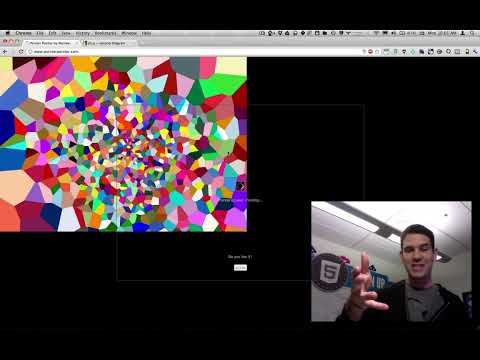
HN links it as the author's own breakdown of Pointer Pointer's inner workings.

HN mentions it as an early example of corpus-based concatenative synthesis and audio-matching techniques.

It comes up as an example of challenging, dense electronic music and as a hand-made visual-sync piece predating generative tools.

Pointed to as a nice overview of implementing ASCII rendering as a post-processing shader.

Shared as an example of simple rules yielding complex emergent, life-like behavior, alongside Game of Life and particle simulators.

Linked in threads about algorithmic and demoscene music as the canonical introduction to bytebeat.

Cited in glitch-art threads as the non-programmatic way to datamosh by deleting keyframes.

Cited as a standout example of datamoshing and codec-corruption aesthetics in threads on video compression and glitch art.

Cited as an example of artists hiding visuals in audio spectrograms.

HN commenters use it as an illustration of how simple rules can produce surprisingly complex behavior.

HN uses it as the canonical example of hiding images in audio spectrograms.

Used as an example of computer-generated music in threads on AI creativity and music.

Cited as a vivid demonstration of generation loss from repeated lossy re-encoding.

HN cites it as a playful example of attacking crowd-sourced traffic data and of how automated systems can be fooled.

Cited by HN as a fun example of a laser projector side project that later led to jobs and wealth for its author.
Which of these have you already seen?
Connect YouTube and HackerTube AI hides what you've watched and ranks the rest for you.